
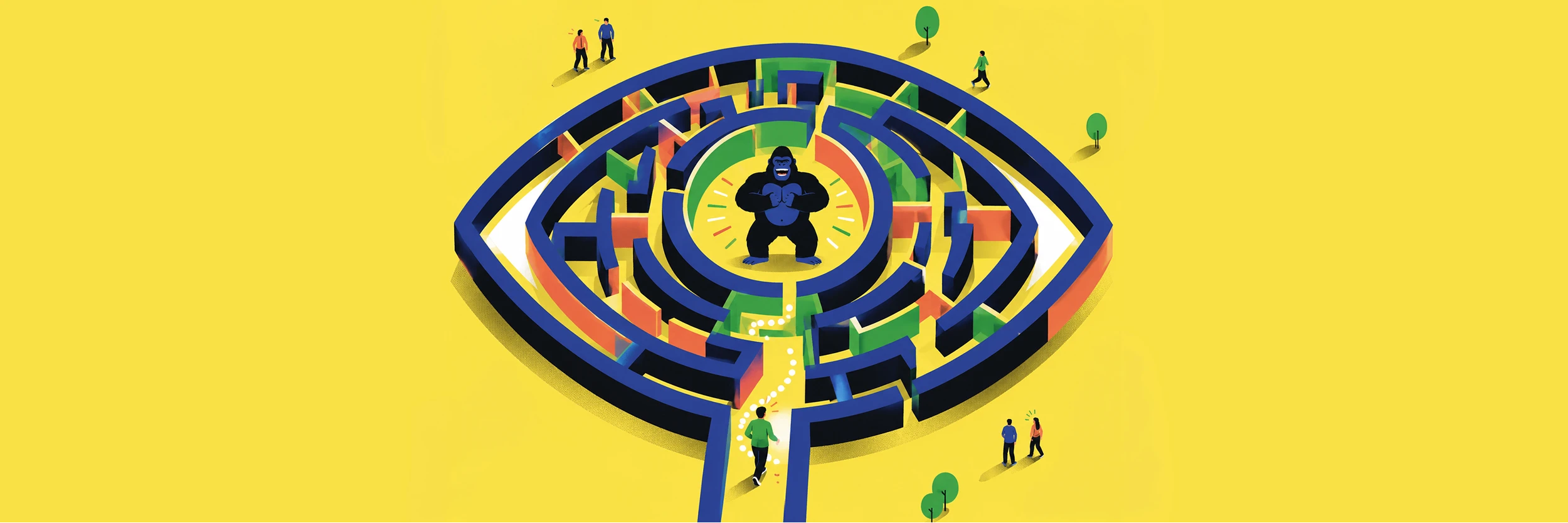
To see the Invisible Gorilla
Why seeing isn't always the same thing as paying attention.
By Gus Silber
Sometime during the pandemic – it must have been during the second or third lockdown – I had an epiphany that changed the way I look at the world.
I lost my glasses.
I couldn't find them anywhere. I looked under the sofa cushions, under the bed, under the kitchen table. I looked in the mirror to see if I was wearing them on top of my head.
Nope.
Since I only really wore them for driving (I could see people just fine on Zoom), it wasn't too much of a crisis.
Nonetheless, as soon as the regulations relaxed to Level 1, I got into my car and drove to an appointment with my optometrist. Only when I got there did I realise I had driven all the way without my glasses.
What I first took to be a miracle, a symptom of what we then referred to as "the new normal", turned out on closer examination to be a minor adjustment in my prescription.
My myopia, as the optometrist explained, was mild enough to allow me to get by without spectacles for everyday use, even while driving, an observation confirmed when I had my eyes tested while renewing my licence.
So I haven't worn them since, although I do keep the replacement pair at home, just in case. ("If they're not on the face, they're in the case," the optometrist reminded me.)
I still use the magnifying app on my iPhone to read the cooking instructions on food packaging – doesn't everyone? – but other than that, well, as Johnny Nash sang, I can see clearly now.
But thinking about seeing made me think about how often we use our sense of sight as a synonym for understanding.
"Do you see what I mean?" we say, even when there's nothing to actually see. "Oh yes, I see now!" comes the response, if we're lucky.
This is because sight is the primary means by which we perceive the world, except, of course, when the world is hiding in plain sight.
In a famous experiment in 1999, Daniel Simons and Christopher Chabris, cognitive psychologists at Harvard, showed students a short video of people passing basketballs to one another.
They asked the students to count the number of passes made by players wearing white shirts.
Focused on the task, many failed to notice a person in a gorilla suit walking into the scene, stopping, beating their chest, and walking off again.
The gorilla was visible for several seconds, yet roughly half the participants never saw it.
The experiment became known as The Invisible Gorilla, and it proved a point about perception that we easily overlook.
Seeing is not the same as noticing. Attention is a spotlight. When we shine it, like a torch in the dark, the rest of reality can dim around the edges.
Perhaps that is why a period of disruption – a pandemic, illness, even losing a pair of glasses – can alter the way we perceive the world. It forces us to look differently. It reveals that we were never looking as carefully as we thought.
Clarity, you see, is not always an effect of sharper vision; sometimes it simply means we are recognising the gorillas we have trained ourselves not to see.
The pandemic was, among many other things, a global experiment in attention. Suddenly we noticed things we had long taken for granted. Hands: whether they had been washed, whether they reached out, whether they had touched a railing.
We noticed distance. We became acutely aware of the air itself, an element that was otherwise invisible and unremarkable. Time changed, too. Days blurred, but certain moments sharpened.
Many of us became hyper-aware of our immediate surroundings – the walls that contained us, the supermarkets with their cordoned-off foodstuffs – while losing sight of longer horizons.
Attention contracted. For others, it expanded, as they reconsidered careers, relationships, priorities. It was as if millions of people were trying on a new prescription for seeing the world.
We like to imagine clarity as something objective, a higher-resolution version of reality. Put on the right glasses and everything snaps into focus.
But clarity is more complicated than that. It has less to do with 20-20 vision and more to do with recognising where our attention is directed, and who or what is directing it.
News headlines compete for it. Social media monetises it. Entire industries are built around keeping us focused on one thing, while another walks through the frame wearing a gorilla suit.
We inherit ways of looking at the world from parents, teachers, algorithms, and assumptions. Then, just like that, life misplaces our spectacles.
We squint for a while. We adjust. When the world finally swims back into focus, it is not always the same world we saw before. Or could it be us who have changed?
I'd love to be able to tell you, as soon as I can remember where I left my glasses.
*You can see the Invisible Gorilla experiment at https://www.youtube.com/watch?v=vJG698U2Mvo. Be sure to pay attention!