
"No space for just in case!"
By Gus Silber
Ingrid Lotze and Gavin Moffat, husband and wife and partners in a communication and training consultancy, were sitting on the couch watching the romantic comedy, While You Were Sleeping, when the big idea struck.
The film starred Sandra Bullock, but for Gavin the real attraction was snow-covered Chicago. “Wouldn’t it be amazing to live there for a month?” he said.
For almost 20 years, the couple had lived in a house in Westdene, Johannesburg, with a garden and four hadedas that Ingrid had named and trained to follow her to the back door for food.
They were in their 50s and their business was thriving, but they felt restless. Gavin’s passing thought became a “what if?” and, eventually, a plan.
On April 27, 2022 – Freedom Day – they left South Africa after selling their home and giving away or selling most of their belongings.
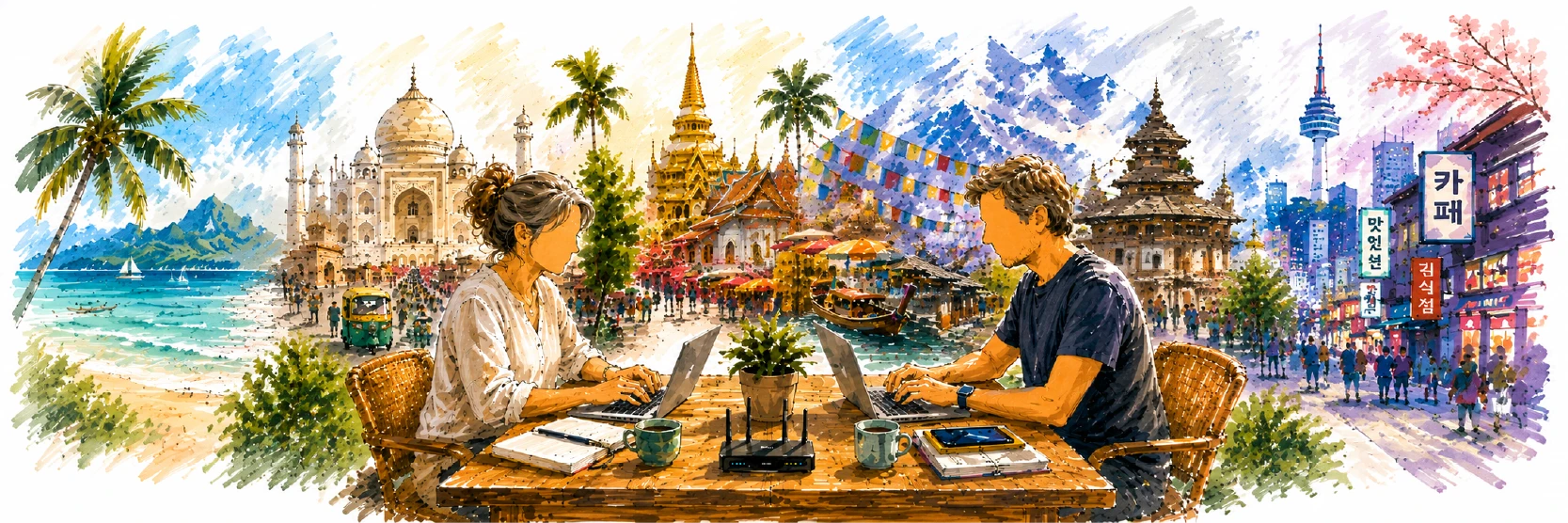
Four-and-a-half years later, they have lived in 33 towns and cities across 13 countries, including Mauritius, India, Kenya, Nepal, Laos, Thailand and South Korea.
Their goal was never to escape work or take an extended holiday. They wanted to remain productive while discovering what it meant to live, not simply travel, in other parts of the world.
The couple’s philosophy, “No Space for Just in Case”, began as a practical rule written on masking tape and stuck to their bathroom mirror as they cleared out their home.
It has since become a broader question about the possessions, commitments and contingency plans people carry through life.
Here, they discuss the realities and rewards of working their way around the world.
How do you choose where to live?
We avoid young, nightlife-driven areas. We would rather stay somewhere local and less touristy because our intention is to experience the culture, not sit inside a bubble surrounded by Western food and entertainment.
We compare platforms such as Airbnb, Booking.com and Agoda with local short-term rental sites. Accommodation must function as both our home and office.
Because we have separate clients and coaching conversations, we need two bedrooms or at least two distinct rooms. We also look for stable Wi-Fi, a sensible workspace and somewhere to exercise.
A beautiful apartment with a fabulous sea view becomes considerably less fabulous when there is nowhere suitable to sit with a laptop for eight hours.
What technology keeps your business running?
We each carry a MacBook Air, iPad Air, iPhone 13 Pro and portable mobile Wi-Fi router, as well as microphones, webcams, AirPods, backup drives, laptop stands, keyboards and mice.
When you work for hours at dining tables and in hotel rooms, an ergonomic setup stops being a luxury.
Stability matters more than raw internet speed when you are facilitating online training or meeting a client.
We research connectivity before booking and identify nearby coworking spaces or cafés as alternatives. Where electricity is unreliable, we look for accommodation with a generator.
Our portable routers and mobile data are the first backup. We assume something will eventually fail and make sure we have another way to connect before we need it.
What does an ordinary working week look like?
We work Monday to Thursday, as we have for at least two decades. A normal day is six to eight hours, including client work, content creation, business development and virtual coffees.
We arrange our schedules around South African time. South Korea was the most difficult, with a seven-hour difference, so we worked afternoons and evenings but restricted clients’ booking times to avoid midnight meetings.
We travel only on Fridays, protecting our productive days. In some countries, the time difference gives us free mornings to explore before work.
Have any destinations been particularly difficult?
Nepal was harder than expected because the internet was unreliable and there were few suitable cafés. Many were small, and we felt it would be rude to occupy one of only a handful of tables for hours.
In Laos, local SIM cards did not solve our connectivity problems, so we sometimes worked in or near hotels with more stable Wi-Fi. We managed power cuts in India and Thailand by choosing accommodation with generators.
We generally travel during the shoulder season to avoid extreme weather and large crowds.
The exception was Thailand during monsoon season, when we experienced the worst flooding in 40 years. We treated it as an adventure, and seeing how Thai communities supported one another was a privilege.
How do you manage the administrative side of having no permanent home?
Admin is no more or less glamorous without a permanent home. It is still admin, you’re simply doing it without the filing cabinet.
We keep detailed records of destinations, accommodation, flights, costs, visas and supporting documents.
We have used spreadsheets, Airtable and a virtual assistant to capture expenses from photographed receipts. AI can now automate much of the work that required elaborate systems when we began travelling.
How restrictive is travelling on South African passports?
It can be restrictive and expensive. Visa fees, proof-of-funds requirements and extra paperwork make advance planning essential.
We have not encountered one country that is uniquely difficult for South Africans wanting to work remotely, but our passports can make applications slower and more demanding.
We use digital nomad visas in some countries, allowing us to stay longer while serving South African clients.
These can be easier for established, older nomads to obtain because applicants usually need to show a minimum bank balance and regular income, requirements that can exclude younger people without substantial savings.
We prefer to stay in one place for at least six weeks, so visa conditions help determine where we go and how long we remain.
What are your biggest expenses?
Accommodation is by far the largest. When we tracked everything, it represented 58 per cent of our expenditure and food another 22 per cent. Local transport, data, laundry, clothing, healthcare and other daily costs made up the rest.
Flights are irregular and vary enormously. The budget is affected less by the number of flights than by how often you move between regions or continents.
Travel insurance is expensive but non-negotiable. It can feel like a grudge purchase, yet it has proved its value through hospital visits in Kuala Lumpur, Singapore and Phuket.
Mauritius was more expensive than expected, particularly for imported groceries. India was the biggest surprise in the other direction.
We lived there for five months and found it remarkably affordable for the quality of life. Thailand, Nepal and Vietnam also cost less than anticipated.
The real variable is often not the country but how long you stay. Remaining somewhere for one to three months brings better accommodation rates, fewer transfers and time to discover how locals eat and live. Slow travel is an effective financial strategy.
We are not living off retirement savings. We continue working, so exchange rates and careful budgeting remain part of every decision.
How has travelling and working together affected your relationship?
Communication is the most important thing. We have an advantage because it is our profession: we teach interpersonal skills and constructive conflict, and we have both done substantial self-development work.
We were nervous about being in each other’s pockets every day, but we became stronger partners.
The smallest apartment we have shared was 30 square metres, so we create space through separate activities such as gym, yoga, reading and connecting with friends.
It has not all been rainbows and roses. But we have a choice. Pull apart or pull together. We choose each other, every day.
How does a place change when you stop being a tourist?
Almost everywhere changes. In Thailand, we would drink an early coffee and watch people queue at the same street vendor for breakfast.
Nothing dramatic was happening, which was precisely what made it interesting. When you live across the road, it becomes part of your morning too.
In Amritsar, India, we befriended a tuk-tuk driver who spoke little English, while our Punjabi was considerably worse.
We communicated through translation apps, and his daughter later invited us to celebrate Holi with their extended family.
Suddenly, we were not spectators. We were in someone’s home, sharing food and meeting the family. It was not on an itinerary; it grew from getting to know one person.
On holiday, you ask, “What should we see?” Living somewhere allows you to ask, “What happens here every day?”
What would you tell people who dream of doing something similar?
Start slowly. You do not need to sell your house to test the idea. We began with a month in Margate and another trial working and scuba diving in Sodwana. We packed the suitcases we intended to travel with and learnt what we actually used.
Try a month, then perhaps two or three. You may discover that you enjoy slow travel but still want a front door to return to. That is a perfectly good outcome.
Have financial stability, understand your living costs and decide what version of nomadism suits you.
You also do not need to decide whether you are leaving for four years or forever. You only need to decide whether you want to try the first bit.
What does “No Space for Just in Case” mean?
It does not mean abandoning plan B and hoping for the best. That would be recklessness wearing a catchy slogan.
It asks how much of what you carry, possessions, commitments, obligations and “what ifs”, has outgrown the life you need now. More can feel safer, but eventually what was meant to protect you begins weighing you down.
Minimalism asks, “How little is enough?” Essentialism asks, “What is vital?” We ask, “What is enough, right now?”
What you don’t carry defines where you can go.
Aside from the hadedas, what do you miss about South Africa?
We miss the people, especially the long hug from somebody who knows your whole story. WhatsApp, video calls and long online catch-ups help, but nothing replaces being in the same room.
We miss ordinary things. Mrs Ball’s chutney, Redro fish paste, a Fournos chocolate croissant, good bread, familiar coffee and favourite household brands. We did not realise how much smell and taste contribute to a sense of home.
We also miss South Africans’ warmth, banter and humour. In Johannesburg, a petrol attendant can make your day with a joke.
We did not become nomads because we wanted to leave South Africa. We love it. We wanted to discover what might happen if we lived differently and experienced more of the world.
What we miss is not some grand idea of home, but people, tastes, conversations and familiar rituals.
And yes, we miss the hadedas!
